Piles
- Home
- Piles
Our piles specialist

Dr. Vishal Pawar
(MBBS, DNB, General Surgery, Mumbai)
Dr. Vishal Pawar is an experienced surgeon specializing in proctology, laparoscopic, and general surgical procedures. He provides advanced treatment for piles, fissure, fistula, hernia, gall bladder stones, and other surgical conditions using modern techniques.
Enquiry Form
Treatment of Piles
‘The common people call them piles, the aristocracy call them Hemorrhoids, the French call them figs – what does it matter so long as you can cure them?’
– John Ardene ( 1307-1392 )
We understand that Piles ( Mulvyadh / Bavasir ) may not be a subject you feel comfortable talking about, but there is no need to suffer in silence. If you have piles, you are not alone. It is estimated that piles will affect at least 50% population at some point during their lives, that makes it one in two of us!
Contact now to get Piles cured fast, by an experienced Team of Doctors. Doctors will advice you holistic grade wise treatment options.
Why opt for Noble Surgicare Hospital to root out those Hemorrhoids?
Dr Vishal Pawar, founder surgeon of Noble Surgicare Hospital ( NSH ) and a dedicated Proctologist, till date more than 10,000 patients have been satisfactorily treated for their Piles at Noble Surgicare Hospital. Stapler surgeries are being performed at our centre on routine basis. We brought Leonardo Laser for Piles and Laser Haemorrhoidoplasties ( LHP ) are being performed at NSH frequently.
Patient Testimonials
The regular MIPH/PPH surgery, clearly the most popular technique worldwide, nevertheless has a recurrence rate of 8%. Dr Vishal Pawar, with his immense experience, has modified the procedure by adding Horizontal Mucopexy to it which brings down the bleeding and recurrence rate to <1%.
Noble Surgicare Hospital is a certified centre of excellence for Proctology treatment providing avent grade treatment for Piles, Fissure, Fistula, Constipation , Rectal abscess & Pilonidal Sinus care. With 5 clinics in nearby area, Karanjade, Dronagiri, Seawoods, Ulwe & Pushpak Nagar.
LEARN MORE ABOUT YOUR TREATMENT
I. MCDPA
An innovation of Dr Pawar himself, this is a conservative approach intended to halt and reverse the early disease without any surgical intervention:
- Medication – Creams ( Anoac ) and stool softeners are used.
- Constac – A herbal preparation formulated by Ayurvedic doctors.
- Diet – Counselling by qualified nutritionist to correct any imbalances in diet and chart a diet conducive to healthy bowel habits.
- Physiotherapy – Pelvic floor physiotherapy helps to strengthen muscles in the region.
- Ayurveda therapy – This includes about 6 sessions of enema with medicated herbal oils.
II. LASER HAEMORRHOIDOPLASTY ( LHP ) aka Laser treatment for Piles
Laser Haemorrhoidoplasty is the preferred treatment for Grade 2 and early stages of Grade 3 Piles. This procedure is done under spinal or short general anaesthesia and takes about 20 minutes. Through the natural anal opening, laser energy is applied using a special radially emitting fibre. The controlled emission of laser energy causes vaporization leading the haemorrhoidal mass to shrink
Advantages of LHP
- No cuts, no open wounds
- Less post-operative pain as compared to other procedures
- Healing is excellent as there are no cuts or stitches
- No sense of urgency ( need to rush to the toilet ) after the procedure
- No risk of rectal stenosis
- Patient can return to normal activities within a shorter space of time
Potential drawbacks of LHP
- Burning sensation
- External skin tag thrombosis
III. MIPH ( Minimally Invasive Procedure for Hemorrhoids ) aka PPH ( Procedure for Prolapse and Hemorrhoids ) aka Stapler Haemorrhoidopexy
What is MIPH / PPH?
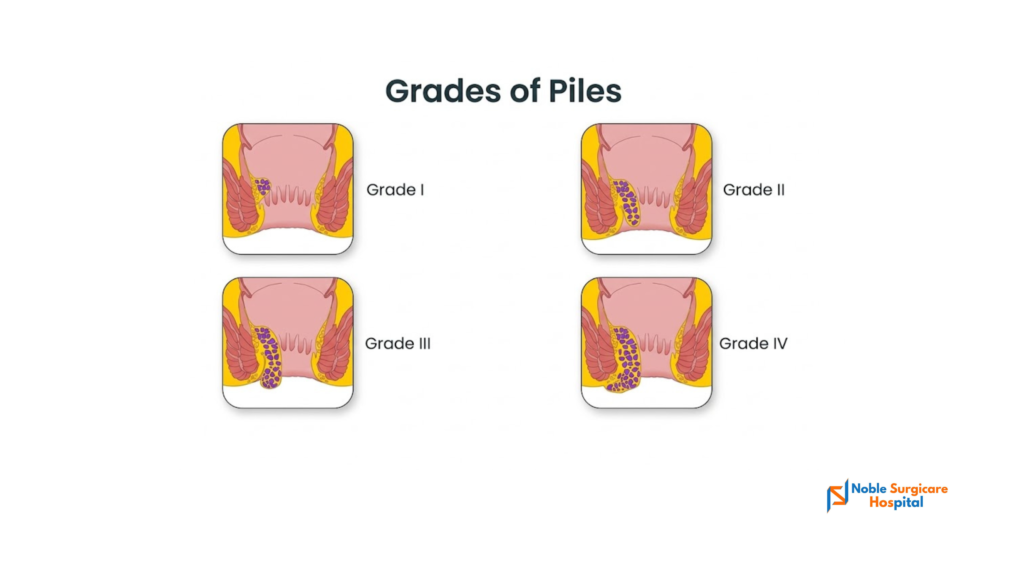
It is a procedure that was originally conceived in 1994 by Dr Antonio Longo, and has since gained popularity as the treatment of choice for Grade 3 and Grade 4 prolapsed Piles.
The procedure is usually done under short general anaesthesia and takes around 25-30 minutes. Using the circular stapler, the mucosa which is responsible for the the prolapse of Hemorrhoids is circumferentially excised and the prolapsed Hemorrhoids are pulled up back to their normal position.
Advantages of MIPH / PPH
The Stapler procedure has definite advantages over other treatments available for Piles ( Mulvyadh ).
- No external cuts / stitches
- Minimal blood loss
- Minimal pain easily managed by painkillers
- Sphincter function is not hampered hence voluntary control over motion is preserved
- Faster recovery – Patient can resume work from 5th day
- Lowest recurrence rate ( 8% ) – This is further brought down to <1% by Mucopexy technique introduced by Dr Pawar at NSH.
- Safe in diabetics, heart patients and senior citizens
Potential drawbacks
As with any surgical procedure there are possible drawbacks associated with MIPH.
- Inflammation or Infection – Can be prevented with anti-inflammatory agents and antibiotics
- Urgency ( i.e. need to rush to the toilet )- May last for 4-8 weeks. This can be kept under control with Kegels exercises
- Bleeding following the procedure ( 6-8% )
- Staple line stricture ( ~5% ) – In experienced hands it can be prevented with proper positioning of staple line
- Recurrence ( 8% ) – With the addition of Mucopexy, this can be brought down to <1%
Causes Of Piles
- Constipation – Most common cause
- Hard stools/ Straining during bowel movement
- Faulty toilet habits ( sitting on the toilet for a long time ex. reading )
- Family history
- Pregnancy and childbirth
- Lifting heavy weights
- Obesity
Symptoms Of Piles
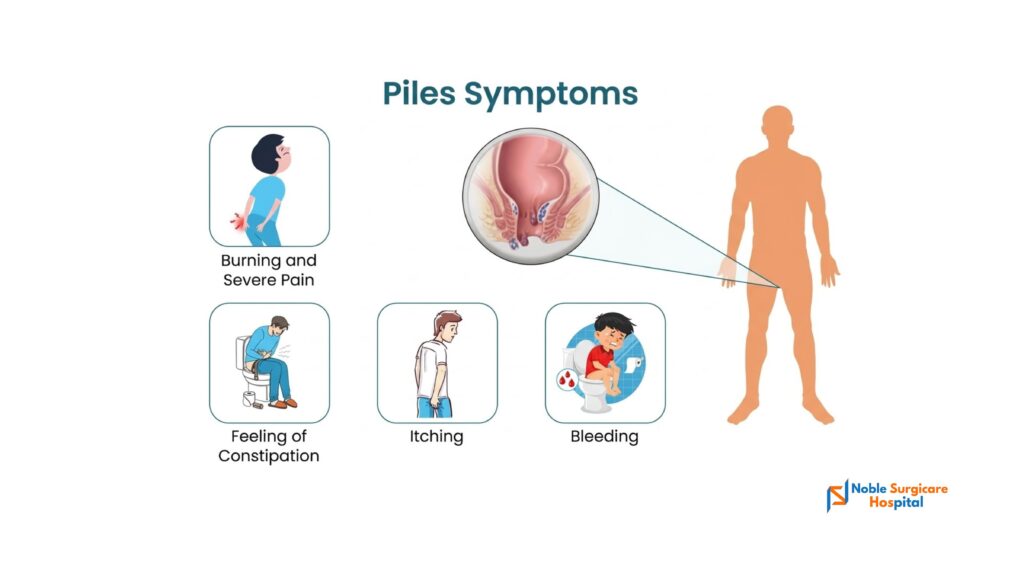
- Painless bleeding while passing stools
- Feeling a lump outside the anus
- Pruritus ani or itching around the anus
- Faecal soiling of undergarments
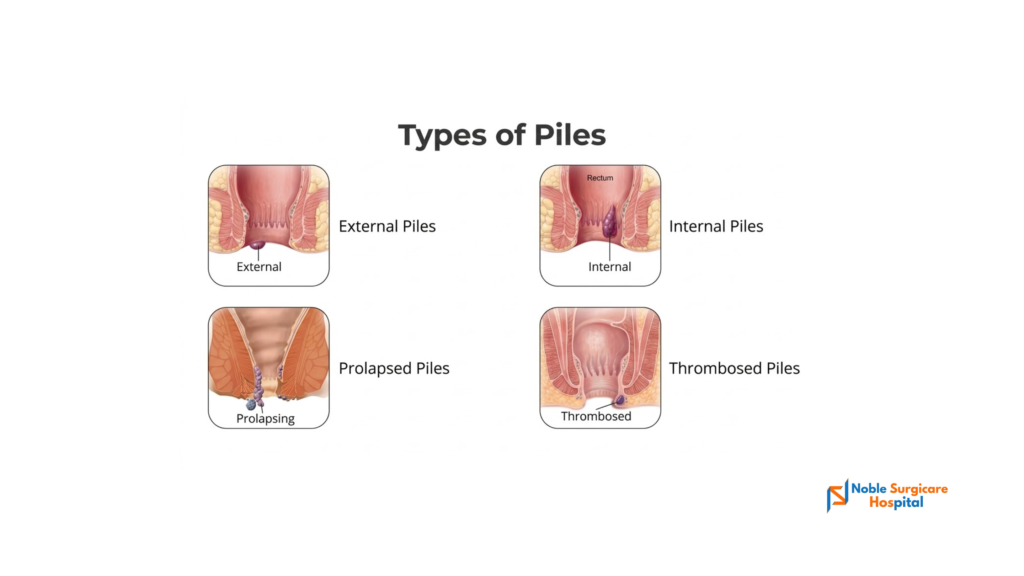
- If a blood clot forms in the haemorrhoid ( Thrombosed haemorrhoid ) it leads to a severely painful swelling which worsens with bowel movement and sitting.
Diagnosis Of Piles
A medical history followed by visual examination of the anus is usually enough. However, a digital examination and Proctoscopy ( a scope is inserted to examine the anal canal ) is done to confirm the diagnosis. At times a Barium study or Colonoscopy may be advised if your doctor suspects any other cause of bleeding that needs to be ruled out.
Frequently asked questions
We understand that no matter how innocuous the procedure or how adroit the surgeon, going through a surgery can be a daunting challenge even for the lionhearted. Therefore, we have answered a few queries that you may still have, to give you a clearer picture of your journey towards a Piles-free you!
What is the best treatment for piles?
Depending upon the severity of the disease piles can be classified into 4 grades. Initial grades of piles can be treated with medications, physiotherapy and ayurvedic treatment. But if the disease advances then surgery is recommended. Laser surgery for piles or hemorrhoids is painless and bloodless. Also there is negligible recurrence rate after the surgery.
How do you treat piles?
Piles can be naturally treated at home by simple lifestyle modifications. It includes physical activities, increasing fluid intake and including diet rich in fibers. Ayurvedic oil therapies can also be used to treat initial stages of piles. If these remedies don’t work then surgery is recommended.
Why do you get piles?
Piles occurs when there is increased pressure on blood vessels near the anus. The main cause of piles is chronic constipation. Other causes include sitting for a long period of time, obesity, pregnancy and lifting heavy weights.
Can general physician treat piles?
One must consult piles specialist for piles treatment. As only the specialist can suggest you the right treatment. Piles specialist is known as proctologist or colorectal surgeon.
How do doctors test for piles?
Piles are generally diagnosed through physical examination followed by proctoscopy or in some cases through colonoscopy.
What do I feel during the procedure?
It’s like taking a small nap! All you will feel is a small needle prick during your preparation for the procedure. The entire surgery takes about 30 minutes.
What happens after the operation?
You will normally be able to start drinking water shortly after the procedure and can start eating as soon as you are hungry. You will be able to get out of bed a few hours after surgery.
You are likely to have some pain after the procedure that is easily controlled with painkillers. You can expect a small amount of bleeding and wearing a pad will protect your clothes from getting soiled.
When can I go home?
If your operation is planned as a day care procedure you can go home as soon as the effect of the anaesthetic has worn off, you have passed urine and you are comfortable, eating and drinking. Since a general anaesthetic is used, it is advisable that a responsible adult take you home and stay with you for 24 hours.
Before you are discharged you will be advised about post-operative care, painkillers and laxatives.
What are my visits to the toilet going to be like?
You will normally open your bowels within 2-3 days of your operation. This may be uncomfortable at first and there could be a sense of ‘urgency’ ( need to rush to the toilet ). You may notice mild blood loss after each bowel movement but this will gradually reduce over the next few days. Maintain hygiene, and wash and keep the operation site clean.
It is important to maintain a regular bowel movement that should be well formed but soft. You may need to take prescribed laxatives for 2-4 weeks. Eating a high fibre diet and increasing water / fluid intake will help.
When will I get back to my routine activities?
You can return to normal physical and sexual activities when you feel comfortable. Anal sex should be avoided.
You can return to work usually by the 5th day after the surgery, although this also depends on the type of work you do.
When should I seek help for Piles?
- If you develop a fever above 100 F
- Increasing pain, swelling, redness or discharge
- Severe bleeding
- Constipation >3 days
Enquiry Form

More Information
07208309513