Gall Bladder stones
- Home
- Gall Bladder stones
Gall Bladder specialist

Dr. Vishal Pawar
(MBBS, DNB, General Surgery, Mumbai)
Dr. Vishal Pawar is an experienced surgeon specializing in proctology, laparoscopic, and general surgical procedures. He provides advanced treatment for piles, fissure, fistula, hernia, gall bladder stones, and other surgical conditions using modern techniques.
Enquiry form
What is Laparoscopic Gallbladder Removal Surgery
(Laparoscopic Cholecystectomy)?
What is the gallbladder?
Your gallbladder is a small organ in your upper abdomen. The abdomen is the area in the middle of your body that holds many organs, including the stomach and gallbladder.
What does the gallbladder do?
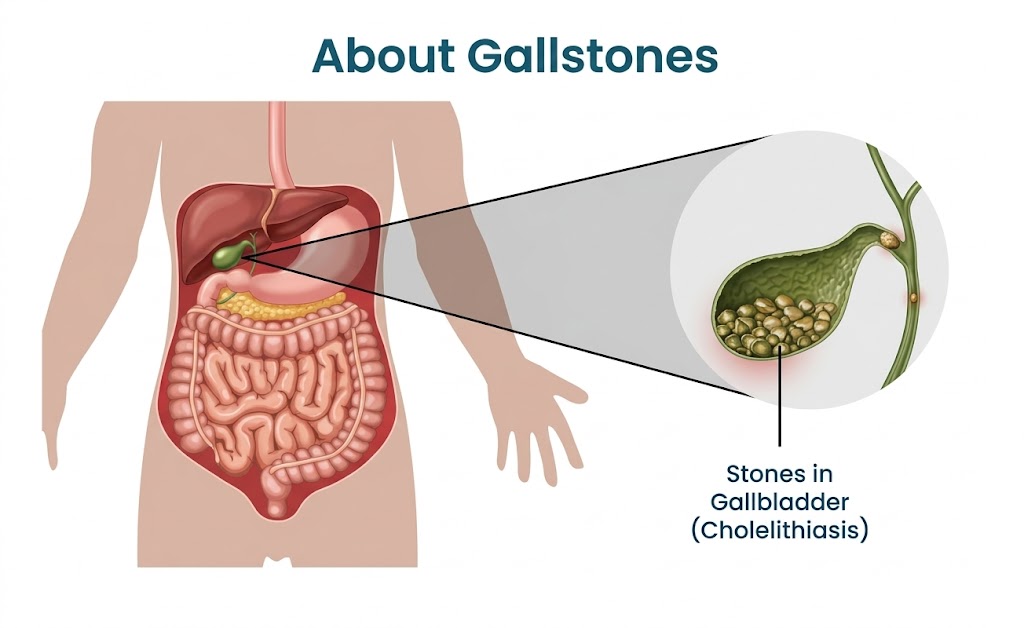
The gallbladder collects and stores a liquid called bile that helps your body break down food. Small, hard deposits called gallstones can form in the gallbladder. This is a common condition. If your gallstones cause health problems, doctors might do surgery to remove it. For example, you might need surgery if your gallbladder is no longer working correctly and you have pain. Your doctor will talk with you about this.
In the past, doctors made a large cut (incision) in the belly to remove the gallbladder. This is called open surgery. Today, doctors can do this surgery with tiny instruments and just a few small cuts. This is called laparoscopic surgery, because the main instrument is called a laparoscope (say “LAP-uh-ruh-scope”). Minimally invasive surgery is a general term for surgery with these small instruments.
What Causes Gallbladder Problems?
Gallstones are often the cause. These small, hard deposits form in the gallbladder. They can also get into the bile duct, which connects the gallbladder with your intestines.
You are more likely to get gallstones if you:
- Are a woman,
- Have had children,
- Are overweight, or
- Are over 40.
You might also get gallstones if other people in your family had them. Doctors do not have a consistent way of preventing gallstones.
What are the symptoms of gallbladder problems?
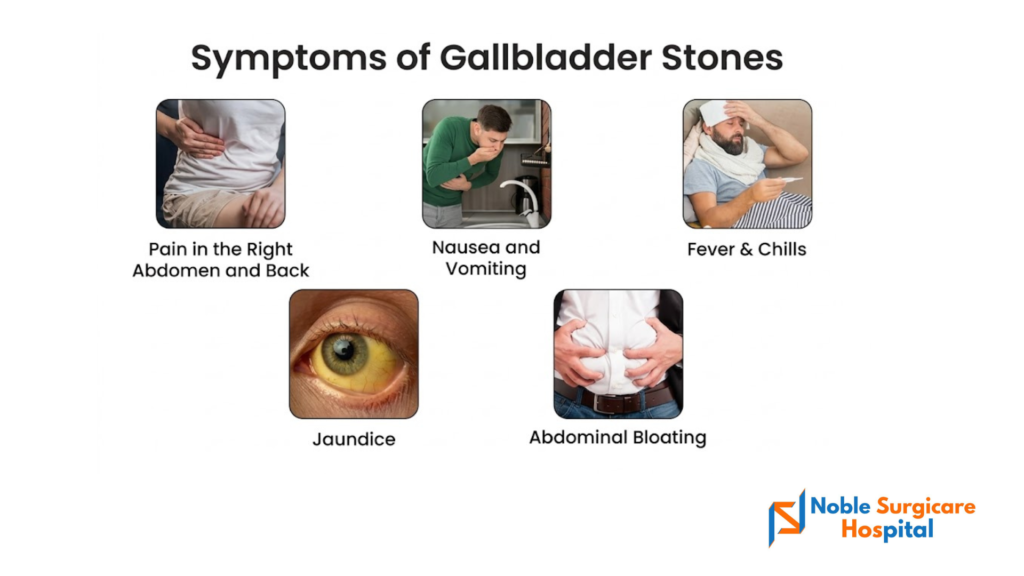
Symptoms can include:
- Sharp pain in your abdomen,
- Nausea and vomiting,
- Indigestion,
- Fever, and
- Yellow skin – Jaundice is the medical term for skin and eyes that look yellow. You might get jaundice if gallstones block your bile duct.
How do doctors find gallbladder problems?
Your doctor will probably order a test called an ultrasound. It shows the inside of the body using sound waves. You are awake during the test, and it does not hurt.
If you need more tests, you might have a CT scan or a test called a HIDA scan. The HIDA scan uses an injection of dye to show how well your gallbladder and bile duct are working.
How do doctors treat gallbladder problems?
Taking the gallbladder out is usually the best way to treat gallbladder problems. You might get some relief from changing your diet. For example, eating less fat can help. But gallstones rarely go away on their own.
You might have heard about treatments to break up gallstones or make them melt away (dissolve). Unfortunately, these do not usually work well.
What are the advantages of laparoscopic gallbladder surgery?
- Smaller incision – Several small incisions, each less than one (1) inch long, instead of a 5- to 7-inch incision for open surgery.
- Less pain than after open surgery.
- Quicker recovery than open surgery – You might go home the same day you have your surgery. You can also go back to regular activities more quickly.
Is Laparoscopic Gallbladder Removal for You?
Laparoscopic gallbladder removal might be the right choice for you because it is the most common type of gallbladder surgery. It might not be an option if:
- You have severe gallbladder problems, or
- You had earlier surgery in your upper abdomen.
Ask your family doctor or other health care provider if this surgery is right for you. You should also talk with a surgeon who is trained and qualified to do laparoscopic gallbladder surgery. They can help you decide.
How Should I Prepare for Laparoscopic Gallbladder Removal?
You will need a full physical examination. You might need some tests to make sure you are healthy enough for surgery.
The surgeon who will do your laparoscopic gallbladder removal will talk with you about the risks and benefits of surgery. Then you will sign a form saying you understand and agree to the operation. Your surgeon’s office will tell you what to do and avoid before surgery. The exact instructions depend on your surgeon, but here are some common things to do.
- Take a shower the night before surgery or the same morning. Your surgeon might ask you to use an antibiotic soap. Please do not shave your belly area.
- Stop eating and drinking at the time your doctor tells you before surgery.
- The morning of your surgery, you may take medications your doctor told you are allowed. Take them with just a sip of water.
- You might need to stop taking certain medicines before surgery. These include blood thinners, supplements, and medicines that affect your immune system. Talk to your surgeon when you schedule your laparoscopic gallbladder removal.
You will need someone to drive you home from surgery. You will also need someone to stay with you overnight. Ask your doctor or nurse how much help you might need.
What is Open Gallstones surgery?
- Open gallstone or gallbladder surgery is medically known as cholecystectomy.
- This surgical procedure usually involves the removal of the entire gallbladder because of recurring cases of gallstones or a severe inflammation or injury caused by them.
- Usually, open gallstone surgery is performed after trying non-surgical or laparoscopic procedures to remove the gallstones or the entire gallbladder.
- Some people may also have specific health conditions that need an open gallbladder procedure.
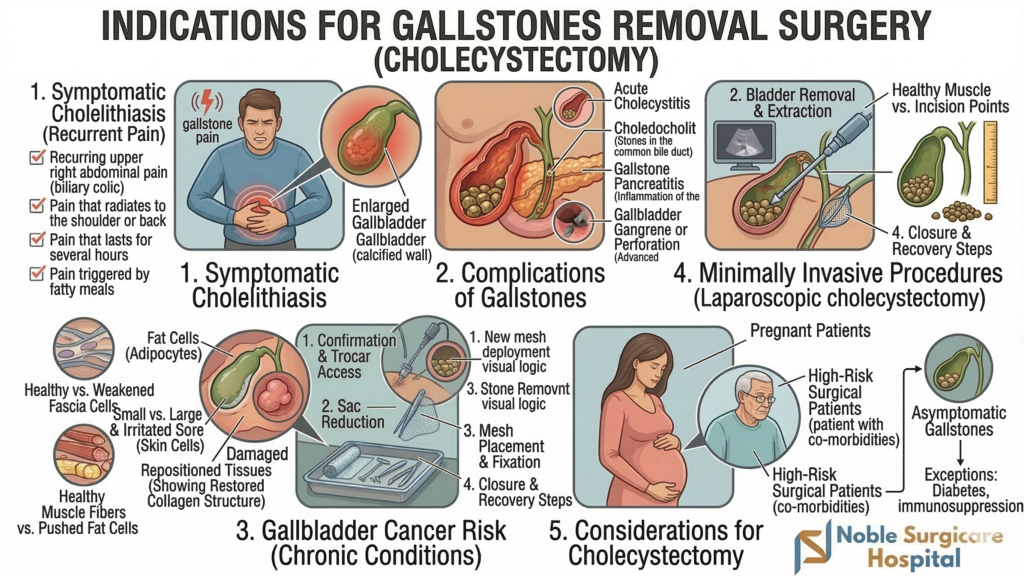
Why Is Cholecystectomy Done?
The doctor may recommend a cholecystectomy if:
- You have gallstones (solid lumps in your gall bladder)
- Your gall bladder is infected, red, or swollen.
- Your gall bladder is cancerous
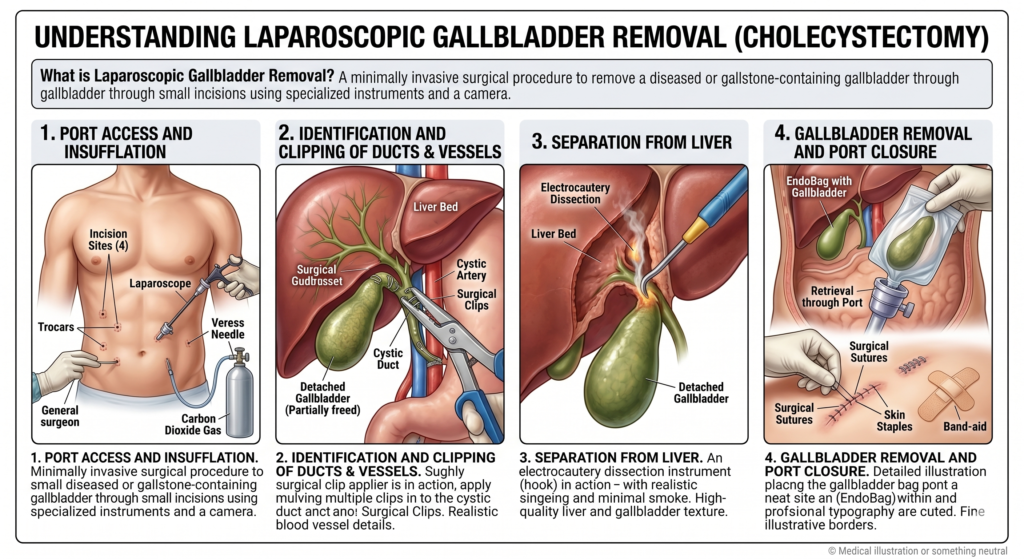
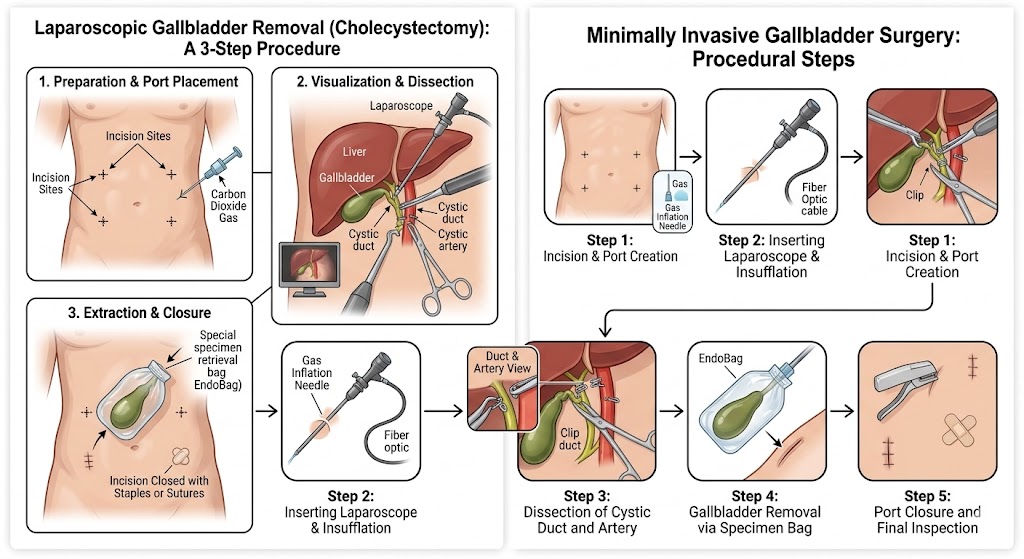
How is Laparoscopic Gallbladder Removal Done?
You will have general anesthesia for your laparoscopic gallbladder removal. This means you are asleep during surgery. When surgery is finished, the surgeon closes your incisions with tiny stitches, staples, surgical tape or glue. These disappear as you heal, so the doctor does not need to remove them later.
Once you are asleep, the surgeon makes an incision near your belly button and inserts a small device called a port. The port creates an opening that your surgeon can use to fill the abdomen with gas. This creates space to do the operation. Next, they insert a small camera through the port. The camera shows the surgery on a screen in the operating room. Once the surgeon can see clearly, they put in more ports to insert long, narrow instruments. Finally, they gently disconnect your gallbladder and take it out through one of the incisions. Most operations need 3 or 4 incisions, but some have more.
What is robotic cholecystectomy?
Your surgeon might use a surgical robot to do your operation. It is done the same way as the description above. Your doctor guides the robot instead of guiding the instruments by hand. This is commonly referred to as robotic surgery.
You might have a specialized X-ray of your gallbladder and bile duct during surgery. This X-ray can find gallstones in the common bile duct. If you have them, the surgeon might need to do additional procedures during the surgery. Or you might need another procedure to remove them later.
It is very important to know about your doctor’s training and experience before your surgery. Ask about their experience doing laparoscopic gallbladder removal and open gallbladder surgery.
What if I Cannot Have Laparoscopic Gallbladder Removal?
A few people cannot have laparoscopic gallbladder removal. You might have open surgery if you are one of these people. Some reasons for having or switching to open surgery are:
- Your gallbladder has a lot of damage – Such as scars or inflammation.
- You have scar tissue in your abdomen from earlier surgery.
- You have obesity – This means being very overweight.
- The surgeon cannot see very well inside your body through the laparoscope.
- You have bleeding problems during surgery.
It is not a complication (problem) if your surgeon decides to switch to open surgery. They will switch if open surgery is the safest option for you. Your surgeon might not know this until after the laparoscopy starts. They will use their best judgment about the safest surgery for you.
What are the Possible Complications of Laparoscopic Gallbladder Removal?
You will probably go back to normal activities within one week. Complications are problems that happen during medical care or after it. Most people who have laparoscopic gallbladder removal have few complications or none at all.
Complications of laparoscopic gallbladder removal (cholecystectomy) do not happen often. They can include bleeding, infection in the surgery area, hernias, blood clots, and heart problems. A hernia is when a small amount of your gut (intestine) or other tissue bulges through the muscles that cover it.
You should also know that any surgery has the risk of hurting other body parts. This is not likely, but it is possible. Gallbladder surgery could hurt nearby areas such as the common bile duct, large intestine (colon), or small intestine. You might need another surgery if this happens. It is also possible that bile might leak into the abdomen after gallbladder surgery.
Most complications from gallbladder surgery are rare, which means they almost never happen. If you are concerned about any possible complication, ask your surgeon.
What to Expect After Surgery
What Should I Expect after Gallbladder Removal Surgery (Cholecystectomy)?
Going home
You can probably go home the day you have your surgery, or you might stay in the hospital overnight. You need to be able to drink liquids before you go home.
Will I be in pain?
You will feel some pain after surgery. Pain at the incision sites and in your abdomen is common. You might also have pain in your shoulders. This is from the air put into your abdomen during the operation. The shoulder pain should go away in 24 to 48 hours.
You can take non-prescription medications to relieve pain, unless your doctor tells you not to. Acetaminophen (Tylenol®) and ibuprofen (Advil®) are examples of non-prescription pain medications. Putting ice on your incisions can also help. Ask your doctor or nurse about the correct way to use ice.
Your surgeon might prescribe a small amount of narcotic pain medicine to help you with pain. Many people recover from surgery without taking any narcotic pain medicine, but some will need narcotics for a few days. If you have questions about pain after surgery, ask the surgeon or your nurses. They should be able to tell you how long the pain will last and what to expect.
You might feel sick to your stomach (nauseated) or throw up (vomit) after your surgery. Having surgery and anesthesia can make this happen. You should feel better in a day or two. Tell your doctor or nurse if you keep vomiting or feeling nauseated.
Activities
You should be as active as your body allows. Doctors recommend walking. You can go up and down stairs on the day of your surgery. The next day, you may take your bandages off, if you have them, and take a shower. You can expect to feel a little better each day after going home. If not, please call your doctor.
You can probably go back to normal activity about a week after laparoscopic gallbladder removal.
If you do a physical job with heavy lifting, ask your doctor when you can go back to work. You can drive 24 hours after you had anesthesia if you are not taking narcotic pain medicines.
If you had an open surgery with a large incision, you need more time to recover. You will probably need to stay in the hospital for a few days after surgery. Expect to go back to full activities in 4 to 6 weeks. You will probably recover more slowly in other ways, too. Your doctor can tell you what to expect.
When to see your doctor after surgery
You need to see your surgeon 2 to 3 weeks after surgery.
When to Call Your Doctor After Laparoscopic Cholecystectomy
Be sure to call your surgeon or family doctor if you have any of problems below.
- Fever over 101 degrees F (38.5 C)
- Severe pain or swelling in the belly
- Yellow skin (jaundice)
- Feeling sick to your stomach or throwing up (nausea or vomiting) – Call your doctor if you cannot eat or drink.
- Blood or pus coming from any of the small cuts in the surgery area – Or redness that spreads or gets worse.
- Pain that your medicines do not help
- Breathing problems or a cough that does not get better.
Call your doctor’s office if you have any other questions about your recovery.
When to See a Doctor?
You can consult your doctor if you experience the following symptoms:
- Pain in the centre or on the right side of your upper belly
- Pain that gets worse after a heavy meal or is constant
- Pain that you can feel in the tip of your right shoulder blade and your back
- Feeling of fullness
- Nausea, fever, chills, and vomiting
- Jaundice (yellow-looking skin)
What to Expect if You Delay Surgery?
If you delay surgery, then you can expect more severe outcomes, such as:
- Continued pain
- Worsening of symptoms
- Infection or bursting of the gallbladder
- Serious illness and possibly death
- Extensive inflammation
- Cirrhosis (a disease of the liver characterised by inflammation of the cells)
Risks of untreated gall stones include:
- Acute cholecystitis (inflammation of the gallbladder)
- Jaundice
- Inflammation (swelling, redness, and tenderness) of the pancrease
Acute Cholecystitis may have the following complications if not treated on time:
- Advanced cholecystitis
- Gangrenous cholecystitis (blood flow to the gall bladder is cut off)
- Empyema of the gall bladder (accumulation of pus)
- Perforation of the gall bladder
Risks of Chronic Cholecystitis include:
- Mechanical or physiological dysfunction of gall bladder
- Acute biliary colic (pain in the abdomen)
- A more severe form of cholecystitis that requires urgent medical assistance (acute cholecystitis).
- Cholelithiasis (presence of gall stones in the biliary tract)
Symptoms That Indicate the Need for Gallstone Surgery
Some gallstones cause no symptoms, while others produce signs that may require prompt treatment.
- Recurring pain in the upper abdomen
- Nausea or vomiting after eating
- Jaundice due to a blocked bile duct
- Inflammation of the gallbladder or acute cholecystitis
- Fever and chills
- Clay-colored stools or dark urine
- Pancreatitis due to gallstones.
Severe or chronic symptoms indicate the need for gallstone removal.
Benefits of removal of Gallstones
- Removing the gallbladder will stop the pain and treat the infection caused by gallstones. It can also stop gallstones from coming back.
- If gallstones are not treated, pain and infection can get worse
Who needs Gallstones removal surgery?
There are many reasons why open gallstone surgery becomes necessary:
- The gallstones block or get lodged in the bile duct, causing a ‘gallbladder attack’. It results in sharp pain in the abdominal region.
- The gallbladder or bile duct is severely inflamed.
- The patient is currently in the third trimester of pregnancy or more.
- You have blood-related disorders like sickle cell anaemia or issues with clotting.
- You consume anticoagulants or blood thinners.
Open Gallstones surgery procedure?
Open Gall Stone Procedure
- The abdominal area is cleansed with a disinfectant.
- A 5-7 inch incision is made under the ribs on the right side of the abdomen. The incision is slanted or up-and-down depending upon the condition of the patient.
- Vitals are monitored throughout the surgery.
- The skin and tissue are pulled back, and the gallbladder is removed.
- The wound is closed with stitches.
- The area is bandaged.
- An open gallstone treatment is a traditional surgical procedure. The alternative is laparoscopic surgery or keyhole surgery, which is minimally invasive. The latter is performed using four small incisions through which special tools are inserted to remove the gallstones, or in some cases, the gallbladder.
- The surgical approach chosen depends upon the severity of the case or the patient’s current health condition.
An open gallstone treatment is a traditional surgical procedure. The alternative is laparoscopic surgery or keyhole surgery, which is minimally invasive. The latter is performed using four small incisions through which special tools are inserted to remove the gallstones, or in some cases, the gallbladder.
The surgical approach chosen depends upon the severity of the case or the patient’s current health condition
What to expect before surgery?
- Pre-anaesthetic checkup or pre-op check-up is performed, including blood work, EKG, HIDA scan, abdominal ultrasound, ERCP, and chest X-rays.
- After studying the medical history and check-up results, the patient is given clearance for surgery, and the surgery appointment is fixed.
- The type of anaesthesia is decided upon based on the patient’s condition.
- The patient must fast for at least 4 hours before the surgery.
- Some medications they are currently consuming may also be temporarily stopped for this period.
- The surgical procedure, post-operative care, and formalities are discussed.
What to expect on the day of surgery?
- Consent formalities from the patient as well as the next of kin must be signed.
- The patient must shower, change into hospital clothing, remove all jewellery, dentures, etc.
- The abdominal region is shaved if required.
- The PAC clearance is confirmed.
- Recommended medication must be consumed with a sip of water.
- Record of previous meals and diet is checked.
- Vitals are monitored.
- The patient is shifted into the operation theatre.
What to expect during surgery?
- The patient is made to lie down on the operating table in a supine position.
- An IV is inserted to administer fluids.
- General Anaesthesia is administered.
- An incision is made on the upper right part of the abdomen to remove the gallbladder.
- The incision is stitched and dressed.
- The entire procedure takes 1-2 hours, depending upon the patient’s condition.
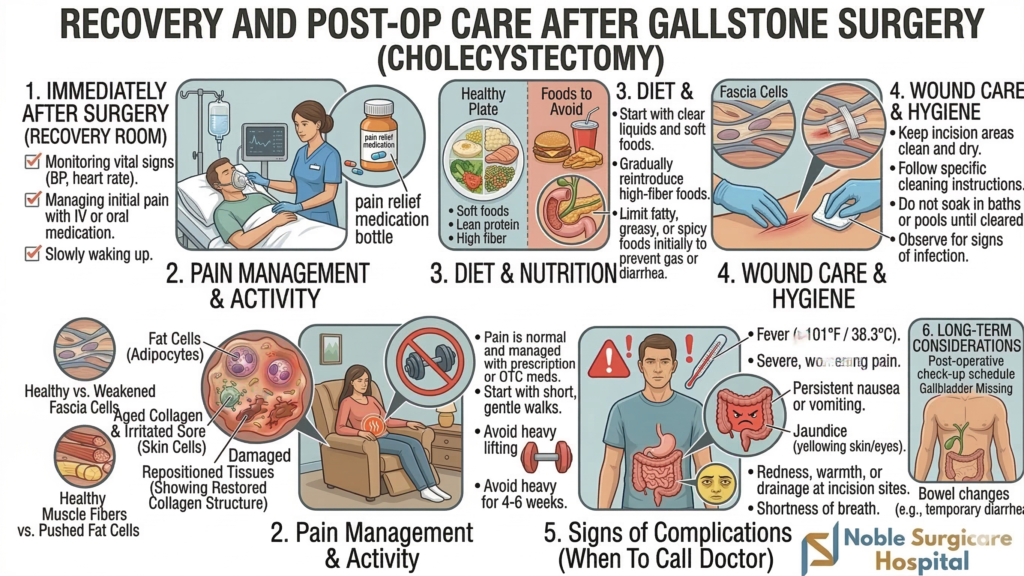
Recovery and Post op care after Gallstones surgery
- The patient is shifted to the observation room to monitor vitals and the effect of anaesthesia.
- If the patient is stable, they are shifted to the ward. If not, they may be placed in the ICU for further observation.
- After open gallstone surgery, the patient may have to stay in the hospital for 2-4 days, depending upon the recovery.
- Medication and pain management procedures are administered during this time.
- Once the patient is stable, they are given detailed instructions about recovery and care and then discharged.
- The patient must continue the use of pain management medication and antibiotics.
- Follow a low-fat diet for the recommended period. Reduce the consumption of fibre and caffeine during the recovery period.
- Drink plenty of fluids.
- Avoid clothing that can rub against the wound.
- Ensure that you wash your hand before and after touching the affected area.
- Resume mild physical activities like walking as the body allows. Avoid stressful physical activity, particularly those that stress the abdominal muscles.
- The wound area must be kept clean and dry. Change of bandage as recommended.
- A patient may resume regular physical activity after 3-4 weeks of the surgery.
- The first follow-up is usually after 2 weeks of the surgery.
- Dissolvable stitches are usually used to stitch the wound. If non-dissolvable stitches are used, they must be removed in 7-10 days of the surgery.
- The area is examined for any swelling or abnormality. Following this, the medication may be stopped or changed as required.
- The doctor will also advise the patient on recommended physical activities and when they can resume their normal lifestyle.
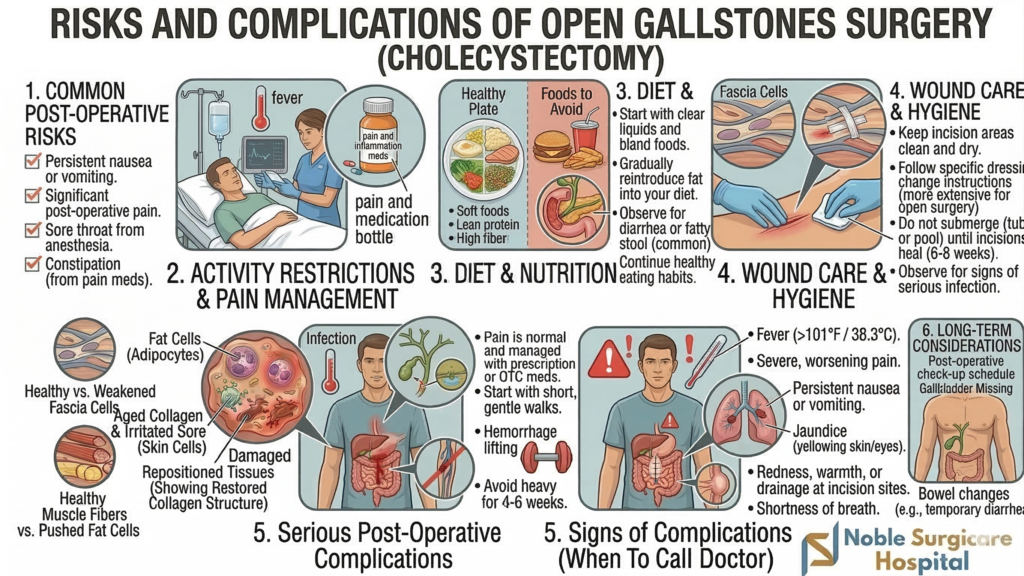
Risk and Complication of Open Gall Stones Surgery
When to consult a doctor?
There may be some situations when you may have to see the doctor before the recommended 2-week follow up:
- The is pain or swelling near the incision that seems to get worse
- You have a persistent fever above 101 degrees F
- A foul-smelling discharge is noticed at the site of the wound
- Vomiting or nausea
- Bleeding and pus around the wound
- Breathing issues
- Unable to eat or drink or have a persistent cough
- You notice a yellowish tinge in the eyes
- The bowel is grey
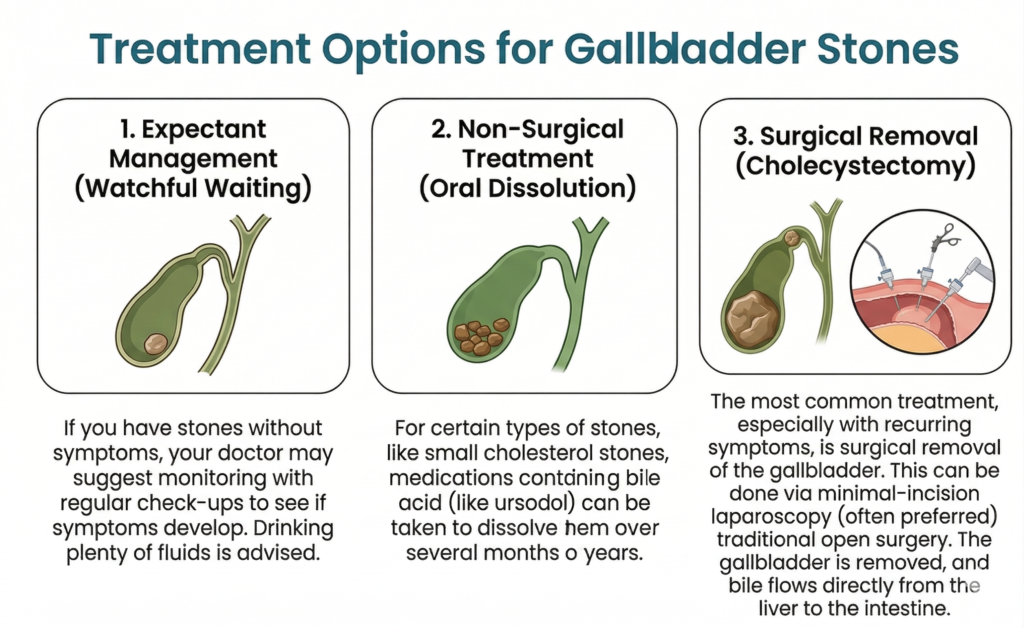
Treatment for Gall baladder stone
Small bladder stones may pass naturally if you increase your daily water intake. Drinking plenty of fluids helps flush the mineral deposits out through the urinary tract. However, if stones are too large, medical intervention becomes necessary to prevent complications.
The most common procedure is a cystolitholapaxy. A doctor uses a thin tube with a camera to locate the stone and then utilizes lasers or ultrasound to break it into tiny pieces. These fragments are then safely washed away from the bladder.
In cases where stones are exceptionally large or hard, open surgery might be required. A surgeon makes a small incision in the bladder to remove the stone directly. This method ensures complete removal when less invasive techniques are not suitable for the patient.
Enquiry form
More Information
07977273728