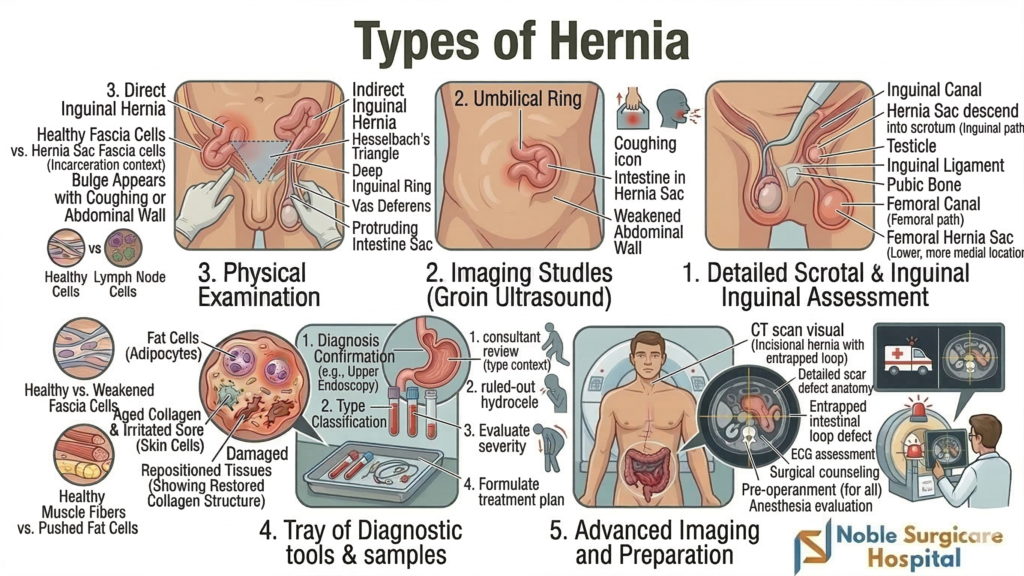

A hernia is a weakness or opening in the abdominal wall, that often results in bulging out of fat or an organ such as intestine, which then occupies space under the skin. The opening in the abdominal wall through which the fat or organs protrude is called the Hernia defect.
Hernia can affect anybody – going by statistics one-in-ten of us will have hernia at some point in our lives. It is found in both sexes, can occur at any age and sometimes infants may be born with it.
Surgery for hernia is one of the most commonly performed operations worldwide with millions of cases being treated every year.
The definitive treatment of hernia is a surgery. With a lot of hernias remaining asymptomatic for long, an obvious question that can arise in one’s mind is, ‘ What if I leave my hernia untreated?’ Well, the general consensus within the medical fraternity is that ‘All hernias should be repaired unless severe pre-existing medical conditions make surgery unsafe’. Many patients, especially those having a smaller, asymptomatic hernia who are anxious of undergoing a surgery still choose to stay away from a surgical treatment. However it should be borne in mind that.
Thus, a wise decision would be to find a hernia specialist and get the hernia repaired as soon as possible. A useful rule of thumb is that once you are sure you have a hernia, it is best to have it treated as early as possible and as well as possible.
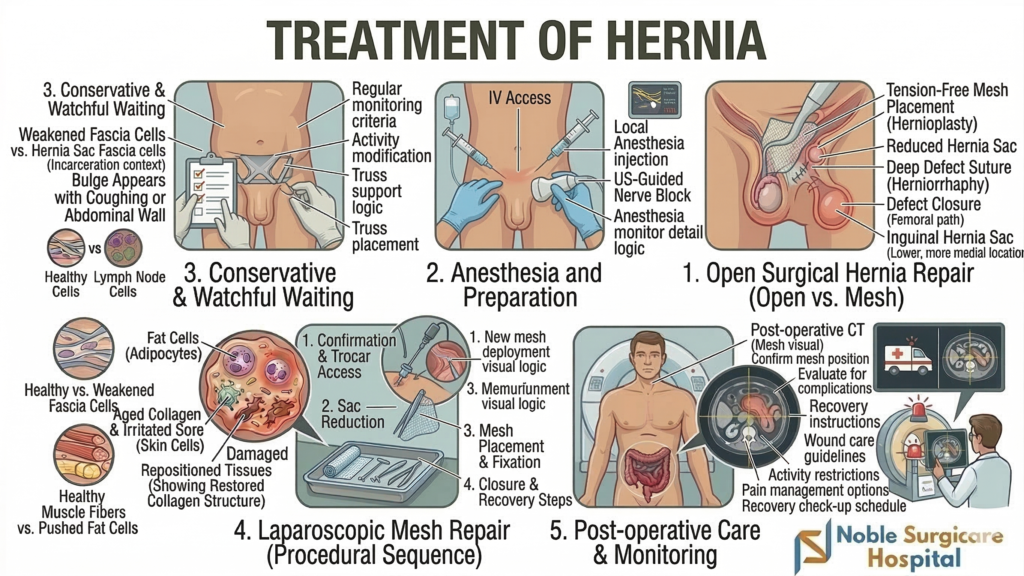
 The goal of a hernia surgery is to repair the weak tissue in the abdominal wall and seal the defect so that fat or intestines cannot push through it again. Depending upon the surgical approach used, there are two types of repairs; Open repair and Laparoscopic ( keyhole ) repair. In an Open surgery, a single long incision ( cut ) is made in the area of the hernia. The herniated organs are pushed back in place and the area is then sutured back with/without placing a mesh to strengthen the weak area of the abdomen. The basic principles of a Laparoscopic repair remain the same, the only significant difference being that instead of a single long cut, several small ( 3-5 ) nicks are made each being about a centimetre long. A laparoscopic repair is done under general anaesthesia and carries more benefits like a quicker recovery, lesser post-operative pain and lower infection rate. However, a laparoscopic repair may not be possible if you have a large hernia or you can’t receive general anaesthesia. It is best to leave the decision to your doctor who will be in a better position to decide which approach would benefit you more depending upon various factors like location/type/severity of hernia as well as your medical history.
     A Femoral hernia repair surgery can be done either as an open surgery or a laparoscopic ( keyhole ) surgery. In the open surgery a single long incision/cut is made whereas in a laparoscopic surgery about 3 small nicks are made. In either of the surgeries, the surgeon reduces the hernia by pushing the fatty tissues/loop of bowel back into the abdomen. This is followed by securing the femoral canal with a mesh to repair the weak spot which let the hernia through.
Both open and keyhole surgeries are safe and effective, although there is lesser pain and a faster recovery after a keyhole surgery. The choice of which technique to use depends upon your general health and the expertise of the operating surgeon.
Umbilical hernia in adults is becoming fairly common due to increasing incidence of obesity and laparoscopy ( Port-site hernia ). A repair may be done in either if the following ways:
To choose the right treatment, it is of utmost importance that you understand what exactly hernia is. The abdominal wall which consists of the abdominal muscles and tendons, holds the abdominal contents in place. These abdominal contents consist of fat and various organs especially the intestines. The abdominal wall envelopes these contents like a corset. If there is any weakness or opening in this wall, the corset like effect is lost and it gives way to the abdominal contents causing them to protrude through the defect. This bulging of the fat/organs is what we call the hernia, which is usually visible as a swelling under the skin. This mechanism is similar to what happens with a bulge in a damaged tyre, where the inner tube, normally contained by the hard rubber of the tire extends out through a thin or weakened space.
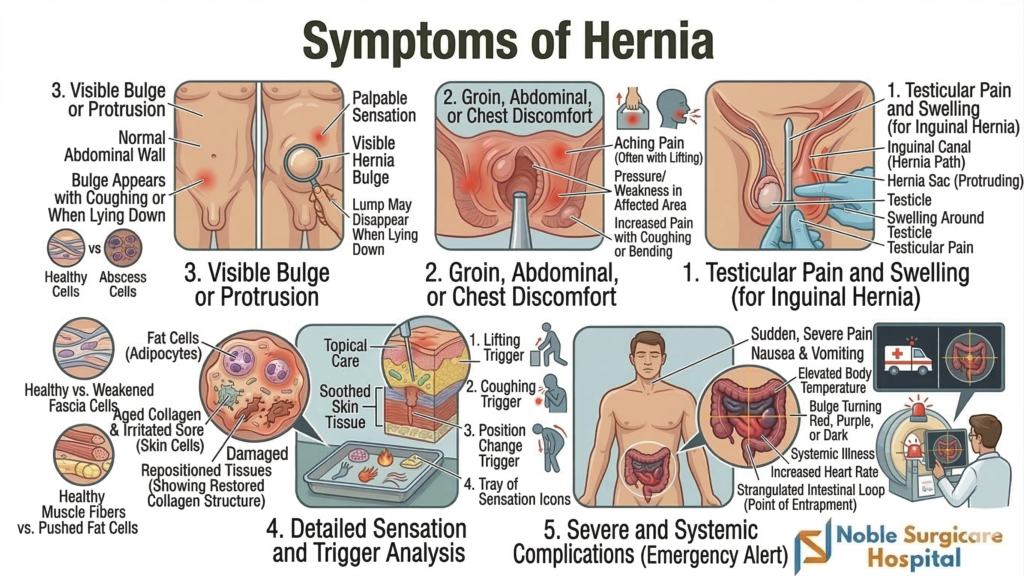
If a loop of intestine or omentum becomes trapped in the weak point in the abdominal wall ( hernia defect ) through which it has herniated, it can obstruct the bowel leading to severe pain, nausea, vomiting and inability to have a bowel movement or pass gas. This is called an Incarcerated hernia. An Incarcerated hernia may cut off blood supply to the trapped intestine. This condition is called Strangulation and it can cause rapid death of that part of the bowel tissue. Any dead tissue within the body can turn extremely hostile very quickly and start releasing toxins in the blood stream which causes Septicaemia ( blood poisoning ) and in turn death, if not treated immediately and aggressively. Strangulation most commonly occurs with the smaller hernias, as the larger ones tend to slide in and out easily and are at a lesser risk of being clamped shut by the muscle opening ( hernia defect ).
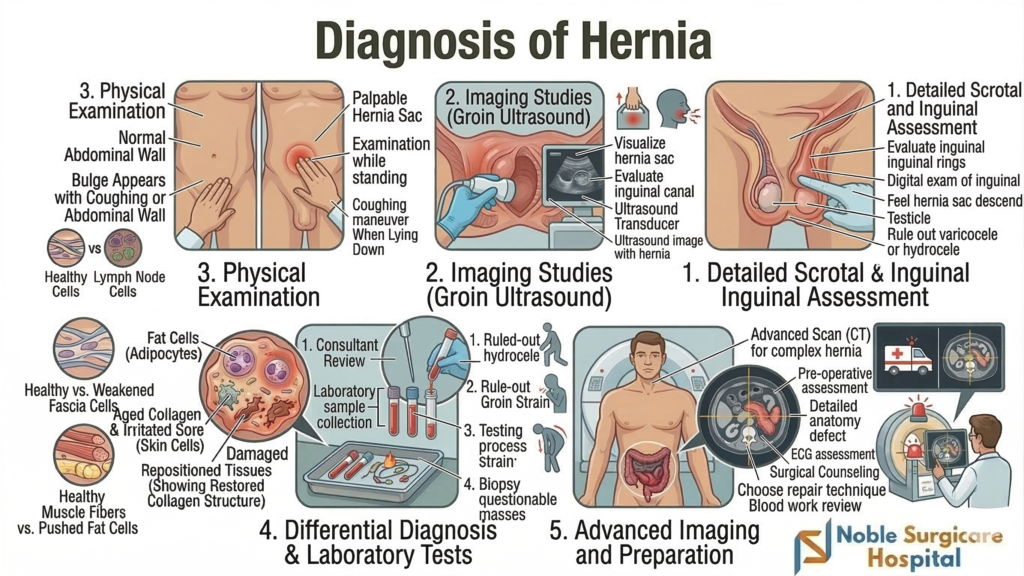
The diagnosis of hernia is usually a clinical one, which means that your doctor will go through a history of your symptoms followed by a brief physical examination. During this check up she/he may feel the area of bulge by raising your abdominal pressure ( this is done by making you stand/cough ), as this manoeuvre makes the hernia more obvious. In case you have an inguinal hernia, the doctor will feel for the potential pathway by examining along your scrotum.To summarise, in vast majority of cases where there is an obvious swelling in the groin/abdominal area, which increases in size on standing, straining or coughing, a clinical diagnosis of hernia is made and NO TESTS are needed. More challenging diagnoses are best performed by hernia specialists
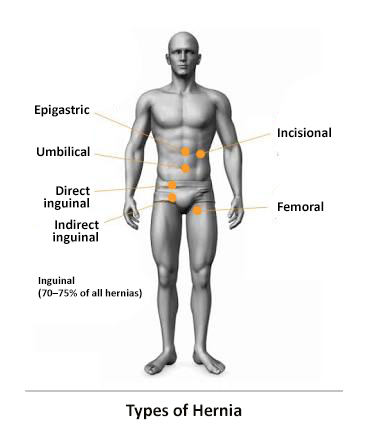
Listed below is a concise description of some of the common hernias. Although there are other types too, they are quite rare and beyond the scope of this piece of information.
91+7977273728